
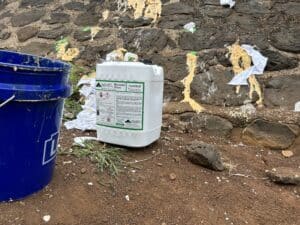
 An abundance of articles, posts, and marketing materials exist regarding specific traits and differences between hydrophilic and hydrophobic polyurethanes. Some of the information is specific to certain types of products while some try to cover polyurethanes as a whole. In other cases, the literature is intended to promote a specific manufacturer’s product. Other articles simply include incorrect statements. The information presented in this post is intended to explain the different traits between hydrophobic and hydrophilic polyurethane based grouts. There are differences in how the liquid resins behave and how the cured polymers behave. A better understanding of the grouts results in better selection of products for specific jobs.
Webster’s Dictionary defines the word hydrophilic as having a strong affinity for water and hydrophobic as lacking affinity for water. Those words maintain the same basic meaning in regard to polyurethane grouts.
How do they work?
Both types of grout (hydrophobic and hydrophilic) react with water and cure. The amount of water required to obtain a complete cure is relatively small in both cases (Typically less than 3%). The differences when comparing the liquids relate to the solubility of the liquid grouts in water. Hydrophobic grouts, such as Mountain Grout HL-100, are typically only compatible with a small amount of water (typically less than 5%) while hydrophilic grouts, such as Mountain Grout Gel Foam I, are compatible with much greater quantities of water (sometimes over 50%). The increased water solubility of hydrophilic grouts can be problematic when injecting into flowing water.
When mixed with small quantities of water both types of grout will react and create an expanded foam. The foam produced from most hydrophobic grouts will be more rigid than the foam from most hydrophilic grouts. When mixed with larger quantities of water, hydrophilic grouts absorb the excess water while hydrophobic grouts repel the excess water. Some hydrophilic grouts produce a soft gel when mixed with very high levels of water (greater than 75%).
What is the end result?
Because the excess water is merely absorbed by the hydrophilic polymer, the foam is subject to drying out as that water is released. This loss of water results in a contraction (or “shrinkage“) of the cured grout. The degree of shrinkage is related to the quantity of water originally absorbed and the degree of drying. For this reason, hydrophilic grouts should be used only in areas where they will not be subjected to drying conditions. Most hydrophilic grouts will gradually re-swell when wet conditions return. Hydrophilic grouts are typically not the best choice for moisture barrier applications because they do allow water to permeate.
Since hydrophobic grouts do not absorb the excess water, they exhibit much better dimensional stability to wet and dry conditions. However, since most hydrophobic grouts have lower elongation properties, they may not be able to bridge the dimensional changes in moving cracks. In these cases, one should select a grout based on its elongation properties which will include most hydrophilic grouts and some hydrophobic grouts.
For more information on the differences between hydrophilic and hydrophobic polyurethanes, please contact a Mountain Grout Tech Rep at 828-456-9970.
Recent Comments