
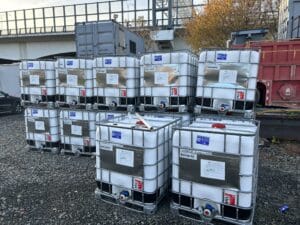
 We are often asked how to best predict Mountain Grout Acrylate’s reaction profile. A predictable reaction profile is key when considering how to efficiently and effectively approach Mountain Grout Acrylate applications. Acrylate’s reactivity is impacted by a variety of factors, such as percent additives (e.g. 0.5%, 1%, 2%, 5%), ambient temperature, pH of groundwater on site, and soil type. Acrylate resins cure by free radical polymerization. This reaction opens the double bonded carbons for crosslinking. Free radicals can be produced by ultra violet light or an oxidizing agent, such as sodium persulfate. It just so happens that sodium persulfate is the additive to the Mountain Grout Acrylate.
The rate of reaction is controlled by several factors. Like most chemical reactions, the temperature is important. Higher temperatures make the molecules more active and results in faster reactions. With Acrylates, the rate at which free radicals are generated will influence the rate of the polymerization. Some materials act as retarders and will essentially absorb the free radicals and inhibit the reaction. The generation of free radicals by the sodium persulfate is initiated by the higher pH caused by the TEA in the water side of the mixture. Therefore, it is understandable that if injecting into alkaline or acidic water, the reaction rate will be altered.
When there is concern about the existence of pH variables or the presence of potential retarding agents, it is best to proceed with reaction tests on site to have confidence in the process. There is really no substitute for on site conditions to determine Mountain Grout Acrylate’s reaction profile. No laboratory testing can replicate the conditions where you’re standing on the jobsite. For more information on how to increases certainty about reaction profiles, please reach out to a Mountain Grout Technical Rep.
Recent Comments